
When enterprises decide to migrate from legacy platforms like SAS, Informatica, or DataStage, the first question is usually straightforward: we need to modernize. The second question is harder: what do we migrate to? For Python-based data engineering, two targets dominate the conversation — Polars and PySpark. Both are powerful. Both have strong communities. And choosing the wrong one for your workload can mean over-engineering simple pipelines or under-powering complex ones.
This article provides a practical, head-to-head comparison of Polars and PySpark as migration targets — covering architecture, performance, scalability, ecosystem, cost, and the decision framework that enterprises should use when planning their modernization roadmap.
The Migration Target Question
Not every workload needs a Spark cluster. This is the single most important insight for migration planning, and the one most frequently ignored.
Organizations migrating from SAS or legacy ETL platforms often default to PySpark because it is the most well-known distributed processing framework. But "distributed" is not inherently better. It is a tradeoff: distributed systems add infrastructure complexity, network overhead, serialization costs, and operational burden. If your data fits on a single machine — and modern machines with 256GB+ RAM and 64+ cores can handle far more than most teams realize — then distributing that workload across a cluster adds cost and complexity without proportional benefit.
Right-sizing the migration target is not about picking the most powerful tool. It is about picking the right tool for each workload. Some pipelines belong on Spark. Others run faster, cheaper, and simpler on Polars. Many organizations will use both.

Polars — enterprise migration powered by MigryX
Polars: Single-Machine Powerhouse
Polars is a DataFrame library written in Rust on top of Apache Arrow. It runs on a single machine and exploits every resource that machine offers: all CPU cores, the full memory bus, and the cache hierarchy that modern processors depend on for performance.
Multi-threaded by default. Every Polars operation automatically parallelizes across all available CPU cores. A .group_by().agg() on a 32-core machine uses all 32 cores without any configuration. There is no cluster to set up, no executor allocation to tune, and no shuffle to optimize.
Lazy evaluation with query optimization. Polars' LazyFrame API builds a logical query plan that the optimizer rewrites before execution. Predicate pushdown, projection pruning, and join reordering happen automatically. This is the same class of optimization that Spark's Catalyst provides, but without the JVM overhead or cluster coordination.
Up to 50x faster than pandas. On the TPC-H benchmarks, Polars consistently outperforms pandas by 10-50x depending on query type. For single-machine workloads, Polars also frequently outperforms PySpark — because it avoids the serialization, network, and coordination overhead that distributed systems impose even when running on a single node.
Handles datasets up to ~100GB on modern hardware. With its streaming engine (.collect(streaming=True)), Polars can process datasets that exceed available RAM by processing them in batches. On a machine with 128GB RAM, datasets up to 100GB or more can be processed efficiently. This covers the vast majority of enterprise analytical workloads.
MigryX: Idiomatic Code, Not Line-by-Line Translation
The difference between MigryX and manual migration is not just speed — it is code quality. MigryX generates idiomatic, platform-optimized code that leverages native features of your target platform. A SAS DATA step does not become a clunky row-by-row loop — it becomes a clean, vectorized DataFrame operation. A PROC SQL query does not become a literal translation — it becomes an optimized query that takes advantage of your platform’s pushdown capabilities.
PySpark: Distributed Scale
PySpark is the Python API for Apache Spark, the dominant distributed data processing framework. It runs on clusters of machines and is designed for workloads that exceed what any single machine can handle.
Petabyte scale. Spark's architecture distributes data and computation across hundreds or thousands of nodes. Workloads that process terabytes or petabytes of data — log analytics, genomics, large-scale feature engineering — require this level of scale. No single-machine tool can match Spark's ceiling.
Rich ecosystem. Spark is not just a processing engine. It is the hub of a mature ecosystem: Delta Lake for ACID transactions on data lakes, MLflow for ML experiment tracking and model deployment, Unity Catalog for data governance, Structured Streaming for real-time processing, and deep integration with Databricks, AWS EMR, Google Dataproc, and Azure HDInsight.
Cloud-native integration. Every major cloud provider offers managed Spark as a service. Databricks has built an entire platform around it. For organizations already invested in cloud data platforms, PySpark is the default compute layer for data lakehouse architectures.
Higher infrastructure overhead. Spark clusters require provisioning, tuning, and monitoring. Executor memory, shuffle partitions, broadcast thresholds, dynamic allocation settings — these are not optional considerations. They are required for production Spark workloads to perform well. A poorly tuned Spark job can be slower than a well-written pandas script on a single machine. This overhead is justified at scale but becomes pure cost at smaller scales.
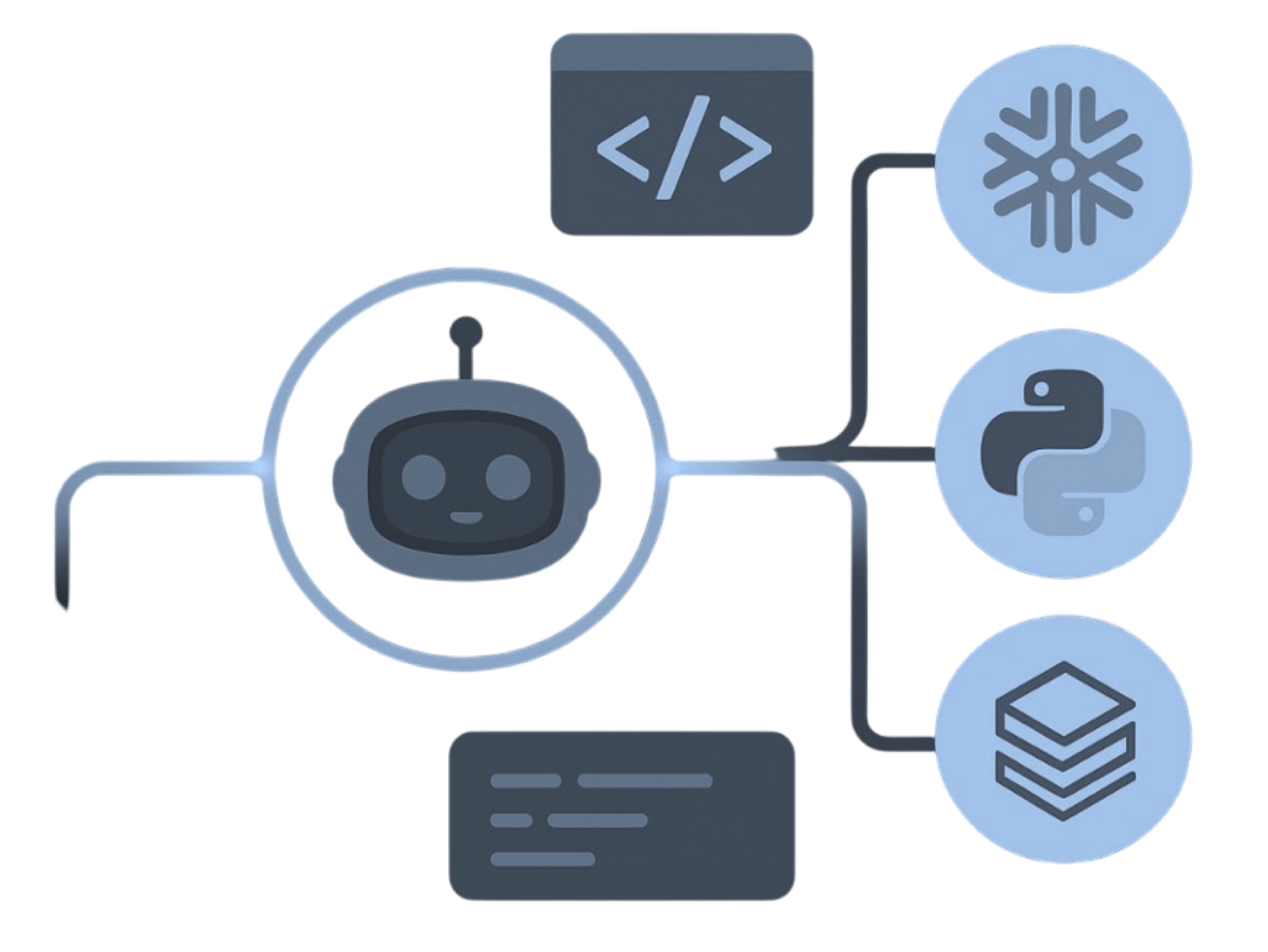
MigryX precision parser — Deep AST-level analysis ensures every construct is understood before conversion begins
Platform-Specific Optimization by MigryX
MigryX maintains deep knowledge of every target platform’s strengths and best practices. When converting to Snowflake, it leverages Snowpark and native SQL functions. When targeting Databricks, it uses PySpark DataFrame operations optimized for distributed execution. When generating dbt models, it follows dbt best practices for modularity and testability. This platform awareness is what makes MigryX output production-ready from day one.
Head-to-Head Comparison
The following comparison captures the practical differences that matter most for migration planning decisions.
| Dimension | Polars | PySpark |
|---|---|---|
| Scale ceiling | Single machine (~100GB with streaming) | Petabytes across cluster |
| Infrastructure | Single machine, pip install polars | Spark cluster (managed or self-hosted) |
| Setup complexity | Zero — install the Python package | High — cluster provisioning, config tuning |
| Learning curve | Moderate — expression API is intuitive | Steep — DataFrame API + Spark internals |
| Query optimizer | Built-in lazy optimizer (predicate pushdown, projection pruning) | Catalyst optimizer (full SQL optimization) |
| Memory efficiency | Excellent — Arrow columnar, zero-copy | Good — JVM overhead, serialization costs |
| Ecosystem | Growing — Python-native, Arrow interop | Mature — Delta Lake, MLflow, Unity Catalog |
| Cloud native | Runs anywhere Python runs | Deep integration (Databricks, EMR, Dataproc) |
| Cost | Low — single machine, no cluster fees | High — cluster compute, storage, managed service fees |
| Best for | Fast analytics, data prep, ETL on single machine | Distributed scale, lakehouse, ML pipelines at scale |
Decision Framework
Choosing between Polars and PySpark is not an either/or decision at the organizational level. It is a workload-by-workload assessment. The framework below provides clear criteria for each.
Choose Polars When:
- Your data fits on a single machine. If your largest dataset is under 100GB (or under 50GB for complex multi-join pipelines), Polars will process it faster than PySpark on equivalent or lower-cost hardware. The threshold is higher than most teams expect — a machine with 128GB RAM and 32 cores handles more data than many Spark clusters.
- You need fast iteration. Polars' zero-infrastructure setup means data engineers can develop, test, and iterate locally in seconds. No waiting for cluster startup, no debugging serialization errors, no Spark UI to interpret. This speed advantage compounds across a development team over months.
- Minimal infrastructure is a priority. Organizations that want to avoid Spark cluster management — whether due to cost, operational complexity, or team skill sets — can use Polars to achieve high performance without the infrastructure burden.
- Your team is Python-native. Polars' expression API feels natural to Python developers. There is no JVM stack to understand, no Spark-specific concepts like partitioning or shuffles, and no PySpark/Scala duality to navigate.
Choose PySpark When:
- Your data exceeds single-machine capacity. Datasets in the terabytes or petabytes require distributed processing. This is Spark's core value proposition, and no single-machine tool can replace it at this scale.
- You need a cloud lakehouse architecture. If your roadmap includes Delta Lake, Unity Catalog, or a Databricks-centric platform, PySpark is the natural compute layer. The ecosystem integration is deep and mature.
- ML pipelines at scale are required. MLflow, Spark ML, and the broader Spark ML ecosystem provide distributed training, experiment tracking, and model serving that integrate natively with PySpark data pipelines.
- You already have Spark infrastructure. Organizations with existing Spark clusters, Databricks workspaces, or EMR/Dataproc environments have already absorbed the infrastructure cost. Adding workloads to existing clusters is often cheaper than provisioning new single-machine environments.
The Hybrid Approach
Many enterprises will use both. A common pattern is emerging: use Polars for development and testing (fast iteration, zero infrastructure), then deploy to PySpark for production workloads that require distributed scale. Another pattern: use Polars for data preparation and feature engineering on single-machine datasets, and PySpark for the distributed joins and aggregations that span the entire data lake.
This is not a compromise — it is optimization. Each tool handles the workloads it was designed for, and the organization avoids the cost of running a Spark cluster for jobs that a single machine handles better.
MigryX: Both Targets, One Platform
MigryX supports both targets — convert the same SAS, Informatica, or DataStage source to either Polars or PySpark. Start with Polars for development speed, switch to PySpark for production scale — or use both where each fits best.
The ability to target both platforms from a single migration tool is not a minor convenience. It fundamentally changes migration planning. Organizations no longer need to commit to a single target before the project starts. They can convert their legacy codebase, evaluate both outputs against real data, and make workload-by-workload decisions based on actual performance and cost data rather than vendor presentations.
Migration Planning Recommendations
For organizations beginning their migration journey, the following practical recommendations apply.
Audit your data volumes first. Before choosing a target, measure the actual size of every dataset your legacy pipelines process. Most organizations discover that 70-80% of their workloads process datasets under 50GB — well within Polars' sweet spot. The remaining 20-30% may genuinely require distributed processing.
Start with Polars for quick wins. Polars' zero-infrastructure setup means you can begin converting and running legacy programs within hours, not weeks. This builds momentum, demonstrates value early, and gives your team hands-on experience with the converted code before tackling the larger distributed workloads.
Reserve PySpark for genuine scale requirements. Route only the workloads that truly need distributed processing to PySpark. This minimizes cluster costs, reduces operational complexity, and ensures your Spark infrastructure is sized for actual demand rather than hypothetical peaks.
Use MigryX to generate both. Converting the same source to both targets lets you benchmark head-to-head with real data. The results will be more informative than any theoretical comparison, and you will have production-ready code for both platforms when the decision is made.
The Polars vs PySpark question does not have a single correct answer. It has a correct framework: right-size the target to the workload, measure rather than assume, and use the tools that let you adapt as your data and requirements evolve.
Why MigryX Delivers Superior Migration Results
The challenges described throughout this article are exactly what MigryX was built to solve. Here is how MigryX transforms this process:
- Production-ready output: MigryX generates code that passes code review and runs in production — not prototype-quality output that needs weeks of cleanup.
- Platform optimization: Converted code leverages target platform-specific features for maximum performance and cost efficiency.
- 25+ source technologies: Whether migrating from SAS, Informatica, DataStage, SSIS, or any of 25+ legacy technologies, MigryX handles it.
- Automated documentation: Every conversion decision is documented with before/after code mappings and transformation rationale.
MigryX combines precision AST parsing with Merlin AI to deliver 99% accurate, production-ready migration — turning what used to be a multi-year manual effort into a streamlined, validated process. See it in action.
Ready to choose the right migration target?
See how MigryX converts legacy pipelines to both Polars and PySpark — so you can benchmark and decide with confidence.
Schedule a Demo